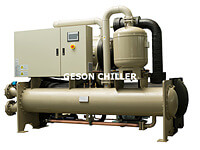
A chemical chiller removes process heat through a controlled recirculating fluid loop. It can serve reactor jackets, mixing vessels, condensers, extraction equipment and other chemical-process heat exchangers. Correct selection starts with the process heat load and required fluid temperature—not reactor volume or nominal chiller tonnage alone.
GESON engineers chemical chiller systems around the buyer’s actual duty. Cooling capacity, compressor power and efficiency are confirmed at the specified entering and leaving fluid temperatures, ambient or condenser-water conditions, flow rate, heat-transfer fluid and glycol concentration.
What Does a Chemical Chiller Control?
The chiller cools a secondary fluid—normally water, a water-glycol solution or another approved heat-transfer fluid. A pump circulates that fluid through the process heat exchanger and returns it to the evaporator. The refrigerant circuit and process chemical normally remain separated.
- Reactor jackets and internal coils: remove reaction heat or pull a batch down to its next process temperature.
- Mixing and storage vessels: maintain a controlled bulk-fluid temperature during agitation, holding or transfer.
- Condensers: provide a defined coolant condition for vapor condensation or solvent recovery.
- Heat exchangers and process loops: remove heat from chemical equipment without exposing the chiller evaporator to the process material.
- Crystallization or extraction steps: support a repeatable temperature profile when the required load and fluid condition are known.
The process engineer remains responsible for reaction safety, relief design and the allowable temperature ramp. The chiller supplier must receive those limits before equipment selection.
Calculate the Process Load Before Selecting Tonnage
A chemical process rarely has one constant heat load. The design load may include reaction heat, sensible cooling of the batch, heat from agitators and pumps, heat gain through the vessel and piping, and simultaneous loads from other users.
For batch pull-down, the required average sensible capacity depends on the mass, specific heat, temperature change and permitted cooling time:
Average sensible load = mass × specific heat × temperature change ÷ pull-down time
This is only one part of the heat balance. Exothermic reaction heat and peak release rate must be supplied by the process designer or derived from validated process data. A selection based only on vessel volume can be undersized during the reaction peak or unnecessarily oversized during normal operation.
Chemical Chiller Selection Data
| Required input | Why it affects selection |
|---|---|
| Application and process equipment | Defines whether the duty is reactor control, batch pull-down, condensation, storage or a combined loop. |
| Steady and peak heat load | Establishes required capacity and whether buffer volume, staging or redundancy should be evaluated. |
| Entering and leaving fluid temperatures | Sets the evaporating duty and the temperature difference used with flow to verify capacity. |
| Required flow and available pressure drop | Allows pump selection against the complete system curve, including jacket, heat exchanger, piping, valves and strainers. |
| Fluid type and glycol concentration | Changes density, specific heat, viscosity, freeze protection, heat transfer and pump power. |
| Air ambient or condenser-water conditions | Determines heat-rejection conditions. Maximum ambient or condenser entering temperature is especially important. |
| Batch profile and pull-down time | Separates short peak duty from continuous duty and prevents selection by average load alone. |
| Materials and chemical compatibility | Defines suitable wetted materials, seals and whether an intermediate heat exchanger is required. |
| Power supply and installation location | Controls electrical design, enclosure requirements, ventilation, altitude and outdoor protection. |
| Destination country and applicable codes | Allows the quotation to identify the required documentation and the written model/certificate scope. |
Air-Cooled vs Water-Cooled Chemical Process Chillers
| Selection factor | Air-cooled chiller | Water-cooled chiller |
|---|---|---|
| Heat rejection | Rejects heat directly to ambient air. | Rejects heat to a condenser-water loop and normally a cooling tower or other heat-rejection system. |
| Site services | No cooling tower or condenser-water pump is required, but clear airflow and the stated design ambient are essential. | Requires suitable condenser-water flow, temperature, treatment and plant infrastructure. |
| Installation | Often simpler where water is scarce or tower maintenance is undesirable. | Can suit larger continuous duties where condenser-water infrastructure is available. |
| Rating condition | Capacity and input power must be stated at the specified process-fluid and ambient conditions. | Capacity and input power must be stated at the specified process-fluid and condenser-water conditions. |
| Project decision | Compare total installed system, water availability, operating conditions, maintenance capability and redundancy—not nominal COP alone. | |
See GESON air-cooled chillers and water-cooled chillers. Final configuration remains project-specific.
Fluid Temperature, Glycol and Freeze Protection
Water provides favorable heat-transfer and pumping performance when the operating temperature and process permit it. A glycol solution may be required for freeze protection or low-temperature operation. The glycol type and concentration must be declared during selection because concentration changes heat capacity, viscosity, pressure drop and heat-exchanger performance.
Do not select concentration from leaving-fluid temperature alone. Confirm the coldest fluid or surface condition that can occur during start-up, low load, shutdown and control transients, then follow the fluid supplier’s concentration and inhibitor guidance. The chiller quotation should state the fluid basis used for capacity and pump selection. For more detail, see how a glycol chiller works.
Flow, Pump Head and Reactor Jacket Pressure Drop
Cooling capacity cannot be verified without flow and temperature difference. The selected pump must operate on the system curve rather than at an isolated catalogue flow. Include pressure losses through the reactor jacket or coil, intermediate heat exchanger, piping, elevation effects where applicable, control valves, strainers and fittings.
Too little flow reduces heat transfer and can trigger evaporator protection. Excess flow can increase pump energy, erosion risk, control-valve authority problems and jacket pressure. Confirm minimum and maximum allowable jacket pressure with the vessel supplier. A buffer tank or hydraulic separation may be considered when loop volume is low, loads switch rapidly or multiple users require different flow patterns.
Wetted Materials and Process Separation
Material selection depends on every fluid that contacts the circuit, its concentration, operating temperature, contaminants, cleaning chemicals and oxygen exposure. Provide a material compatibility requirement rather than assuming a particular metal is universally suitable.
If the process chemical could attack the chiller circuit, create a contamination risk or require special cleanliness, an intermediate heat exchanger can separate the chiller loop from the process loop. Heat-exchanger approach temperature and fouling allowance must then be included in the capacity calculation. Wetted materials, seals and treatment requirements are confirmed in the written proposal.
Temperature Stability, Staging and Redundancy
Required stability should be specified at the process sensor and over a defined operating range. Chiller leaving-fluid control alone does not guarantee reactor temperature stability: jacket area, agitation, sensor position, valve response, loop volume, load variation and control logic all contribute.
- State the allowable process-temperature band and maximum ramp rate.
- Provide minimum, normal and peak loads so compressor staging or capacity control can be reviewed.
- Identify whether production can stop after a single fault.
- For critical processes, evaluate duty/standby equipment, multiple refrigeration circuits, redundant pumps or emergency cooling according to the process risk assessment.
Hazardous-Area and Process-Safety Boundary
A standard industrial chiller must not be assumed suitable for a classified hazardous area. The owner or qualified process-safety engineer must define the area classification, gas or dust group, temperature class, zone/division, installation boundary and applicable local code.
Provide those requirements before quotation. Locating the chiller outside the classified area and transferring cooling through a secondary loop or heat exchanger may be evaluated, but piping, ventilation, leak detection, controls and emergency response remain part of the plant safety design. Any special electrical or certification scope must be confirmed in writing for the exact model; no hazardous-area compliance is implied by this page.
Installation, Commissioning and Maintenance
- Before installation: verify foundation, service clearance, airflow or condenser-water service, electrical supply, piping cleanliness and drainage.
- Before start-up: pressure-test and flush the loop, fill with the approved fluid and concentration, remove air, confirm valve positions and verify flow.
- During commissioning: record entering/leaving temperatures, flow, pressure, ambient or condenser-water conditions, current and control setpoints under a known process load.
- During operation: maintain condenser cleanliness, strainers, fluid quality, glycol concentration, pumps, electrical connections and safety devices according to the supplied schedule.
- For service planning: preserve commissioning records and report alarms together with operating conditions rather than an alarm code alone.
GESON Supply and Documentation
GESON can engineer new chemical chillers using R454B or R513A where the refrigerant, model, destination requirements and application conditions are suitable. GESON can also provide parts or refrigerant-related service for legacy GESON R22 equipment, subject to equipment identification and local regulations.
Applicable units can be supplied with CE and ISO documentation within the model-specific written certificate scope. Standard configurations have a fixed lead time of 30 working days after the technical specification, drawings, payment and other written conditions are agreed. Applicable units are designed for a 40,000-hour trouble-free operating capability within approved application, installation, operation and maintenance conditions; model-specific scope must be confirmed in the written quotation.
Capacity, input power, COP, fluid temperature range, compressor configuration, materials, power supply and documentation are not universal values. They are stated for the selected model and agreed rating conditions.
Request Chemical Chiller Selection
Send the following information for an engineering selection and quotation:
- chemical process and equipment being cooled;
- required steady load, peak load or batch data for load calculation;
- entering and leaving fluid temperatures;
- required flow and available process pressure drop;
- fluid type and glycol concentration;
- maximum ambient or condenser-water entering/leaving conditions;
- materials or compatibility requirements;
- minimum/normal/peak operating profile and redundancy requirement;
- power supply, installation location, area classification and destination country.
Chemical Chiller FAQ
What is a chemical chiller?
A chemical chiller is an industrial refrigeration system that cools a recirculating secondary fluid serving reactors, vessels, condensers or other chemical-process heat exchangers. The refrigerant and process chemical normally remain in separate circuits.
How do you size a chiller for a chemical reactor?
Size it from a validated heat balance that includes reaction heat, batch sensible pull-down, agitator and pump heat, ambient gains, simultaneous users and the required cooling time. Then rate the chiller at the actual entering/leaving fluid temperatures, flow, ambient or condenser-water condition, fluid type and glycol concentration.
Should a chemical process use an air-cooled or water-cooled chiller?
Air-cooled equipment can simplify site services, while water-cooled equipment may suit larger continuous duties where treated condenser water and heat-rejection infrastructure are available. Compare the complete installed system at the project’s design conditions.
Which heat-transfer fluid and wetted materials should be used?
The answer depends on required temperature, freeze protection, viscosity, chemical compatibility, contamination risk and local safety requirements. State the fluid and concentration during selection; confirm all wetted materials and seals in the written proposal.
Can a standard chemical chiller be installed in a hazardous area?
Do not assume it can. A qualified party must define the area classification and applicable code. GESON must review the exact installation boundary and special electrical or certification requirements before making any written supply commitment.
What information is required for a chemical chiller quote?
Provide the application, cooling load or batch data, entering/leaving temperatures, flow, pressure drop, ambient or condenser-water conditions, fluid and glycol concentration, materials, power supply, installation location, area classification and destination country.