
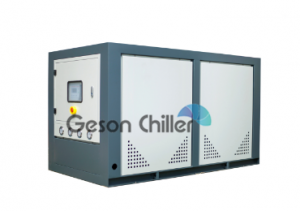
Cooling accounts for up to 70% of the injection moulding cycle time. Choosing the right chiller — correct capacity, temperature setpoint, and configuration — directly affects your production output, part quality, and operating cost. This guide covers everything you need to know before requesting a quotation.
Step 1: Understand What Needs to Be Cooled
In a typical injection moulding operation, three circuits require cooling:
- Mould cooling — the largest heat load, typically 60–70% of total cooling requirement. Chilled water circulates through channels inside the mould to solidify the plastic and enable ejection.
- Hydraulic oil cooling — hydraulic injection moulding machines generate heat in the hydraulic system. A separate circuit at 25–30°C is typically sufficient.
- Barrel throat cooling — prevents premature melting of plastic pellets at the feed zone. Usually a small load, often handled by a separate cooling unit.
Step 2: Calculate Your Required Chiller Capacity
The standard formula for injection moulding chiller sizing:
Q (kW) = W × C × ΔT × S ÷ 860
- W = weight of plastic processed per hour (kg/h)
- C = specific heat of plastic (kcal/kg°C)
- ΔT = melt temperature minus mould temperature (°C)
- S = safety factor (1.5–2.0)
| Material | Melt Temp (°C) | Mould Temp (°C) | Specific Heat (kcal/kg°C) | Typical Rule of Thumb |
|---|---|---|---|---|
| Polypropylene (PP) | 200–280 | 0–80 | 0.48 | 1 ton per 65 lbs/hr |
| Polyethylene (PE) | 160–310 | 0–70 | 0.55 | 1 ton per 55 lbs/hr |
| ABS | 180–260 | 40–80 | 0.40 | 1 ton per 50 lbs/hr |
| Polycarbonate (PC) | 280–320 | 70–130 | 0.30 | 1 ton per 35 lbs/hr |
| Nylon (PA) | 230–300 | 25–70 | 0.58 | 1 ton per 45 lbs/hr |
| PVC | 160–190 | 20–60 | 0.25 | 1 ton per 80 lbs/hr |
Step 3: Choose the Right Chilled Water Temperature
- 10°C – 15°C — standard mould cooling, most common, prevents condensation on mould surfaces
- 7°C – 10°C — precision moulds requiring tight dimensional tolerances
- 25°C – 30°C — hydraulic oil cooling, separate circuit
Important: In humid climates (Southeast Asia, Middle East coastal areas), chilled water below 10°C can cause condensation on mould surfaces, leading to surface defects on moulded parts. Always confirm the dew point temperature for your factory before setting the chiller setpoint.
Step 4: Air Cooled or Water Cooled?
| Factor | Air Cooled Scroll Chiller | Water Cooled Screw Chiller |
|---|---|---|
| Best for | 1–5 machines, small factory | 10+ machines, central system |
| Capacity range | 2RT – 60RT | 50RT – 1,000RT |
| Installation | Simple — no cooling tower needed | Requires cooling tower + pump |
| High ambient (>35°C) | Capacity drops significantly | Stable performance |
| Upfront cost | Lower | Higher |
| Operating cost | Higher for large systems | Lower — better efficiency at scale |
Step 5: Individual Machine vs Central Chilled Water System
Individual chiller per machine — each machine has its own dedicated air cooled scroll chiller with built-in pump and stainless steel tank. Connects directly to the mould cooling circuit. Best for factories with fewer than 5 machines, or where machines run different materials at different temperatures.
Central chilled water system — one or more large water cooled screw chillers supply chilled water to all machines via a distribution manifold. More energy efficient, easier to maintain, lower total installed capacity needed due to diversity factor. Recommended for factories with 10 or more injection moulding machines.
Geson can supply both configurations — from a single 2RT scroll chiller package to a complete central system with chiller, cooling tower, pumps, buffer tank, and distribution manifold.
Real Project References
| Country | Application | Geson Solution |
|---|---|---|
| Oman | PVC injection moulding factory | Water cooled screw chiller 44RT, 12/7°C, R407C, 440V/50Hz + cooling tower + pumps |
| Vietnam | Plastics manufacturing | Air cooled scroll chiller 85RT, skid-mounted package with pump and tank |
| Bangladesh | PVC pipe extrusion | Water cooled screw chiller 213RT, Hanbell compressor, full skid package |
| Russia | Plastic extrusion 800kg/h line | Air cooled scroll chiller 18.6RT, R22, 380V/50Hz |
What to Tell Geson When Requesting a Quotation
To get an accurate chiller selection and formal quotation within 24 hours, provide:
- Plastic material (PP, PE, ABS, PC, PVC, Nylon, etc.)
- Number of injection moulding machines and shot weight per machine (kg/h)
- Required chilled water supply temperature (°C)
- Site ambient temperature (°C) — especially important for air cooled chiller selection
- Power supply (voltage, frequency, phases) — e.g. 380V/50Hz/3Ph or 460V/60Hz/3Ph
- Whether you need individual machine chillers or a central system
Get Free Chiller Selection & Quotation →
Related Resources
- Injection Molding Chiller — Complete Product Guide & Specifications
- Air Cooled Chillers — 2RT to 300RT
- Water Cooled Chillers — 3RT to 1,000RT
- Chiller Refrigerant Types — Complete Guide
- Process Chiller vs HVAC Chiller
- Glycol Chiller Systems
Related project: See how these selection principles were applied to a 155 kW water-cooled chiller serving six injection molding machines in Oman under 24/7 operation and 50°C maximum ambient conditions.