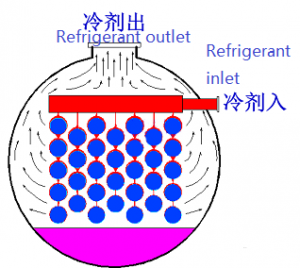
DX, flooded and falling-film describe how refrigerant is fed to and distributed across a chiller evaporator. They are evaporator arrangements—not complete chiller categories—and none is automatically the best choice for every duty. The correct selection depends on the refrigerant, compressor, cooling load, leaving-fluid temperature, fluid type and concentration, part-load profile, maintenance resources and the manufacturer’s tested design.

DX vs Flooded vs Falling-Film Evaporators: Quick Comparison

Selection factorDry expansion (DX)FloodedFalling-film
Refrigerant distributionMetered through organized passages; refrigerant normally leaves fully evaporated and superheatedMost heat-transfer surface remains in contact with a liquid refrigerant inventoryLiquid is distributed over heat-transfer surfaces as a film
Control priorityStable superheat and even circuit feedingLiquid level, separation and oil returnDistributor wetting, liquid inventory, oil management and part-load stability
Refrigerant chargeOften lower than a comparable flooded arrangement, but design-specificUsually requires a larger liquid inventoryCan reduce charge relative to a comparable flooded design; no universal percentage applies
Part-load considerationExpansion-device turndown and circuit distributionLevel control and compressor turndownUniform film distribution as refrigerant flow decreases
Maintenance focusExpansion device, distributor, superheat and foulingLevel controls, separators, oil recovery and tubesDistributor, oil recovery, controls and tube condition

Terminology: “Dry Chiller” Can Be Misleading

In this comparison, dry means a dry-expansion or direct-expansion evaporator. It does not mean a dry cooler, which rejects heat directly to ambient air without a vapor-compression refrigeration cycle. Engineers should use “DX evaporator” when specifying the refrigeration design.

The location of water and refrigerant is not universal. In some shell-and-tube DX evaporators, refrigerant flows through tubes and process fluid flows through the shell. Brazed-plate and other designs use different passage arrangements. Selection should therefore follow the actual heat-exchanger drawing, pressure-drop data and service-access requirements—not a general rule about which fluid must be inside the tubes.

How a DX Evaporator Works

An expansion device meters refrigerant into organized evaporator circuits. The refrigerant boils as it absorbs heat from water, glycol or another process fluid and normally exits as vapor with controlled superheat. This helps protect the compressor from liquid carryover.

  • Advantages: comparatively simple refrigerant management, potentially lower charge and familiar service procedures.
  • Engineering risks: uneven circuit feeding, an oversized or undersized expansion valve, unstable superheat, excessive refrigerant-side pressure drop and poor oil return at low load.
  • Best evaluated by: operating envelope, minimum stable load, expansion-device control range, fluid pressure drop and certified capacity at the required conditions.

How a Flooded Evaporator Works

A flooded evaporator maintains most of the heat-transfer surface in contact with boiling liquid refrigerant. In a typical flooded shell-and-tube liquid cooler, process fluid flows through the tubes while refrigerant boils on the shell side. Vapor must be separated from liquid before returning to the compressor, and liquid level requires dedicated control.

Flooded designs can provide effective heat transfer with a small approach temperature, which can be valuable in suitable low-temperature or high-capacity duties. Their engineering trade-offs include a larger refrigerant inventory, liquid-level control, separation hardware and more demanding oil recovery. Oil retained in the evaporator can reduce heat transfer and threaten compressor lubrication, so the manufacturer’s oil-management design is critical.

How a Falling-Film Evaporator Works

A falling-film evaporator distributes liquid refrigerant over the outside or inside of heat-transfer surfaces so that a thin film absorbs heat and evaporates. Some packaged chillers use this arrangement to reduce liquid inventory and static-head effects compared with a conventional flooded evaporator.

These benefits are design-specific. Distribution must remain sufficiently uniform across the active surface, including at part load. The refrigerant distributor, controls, heat-exchanger geometry and oil-recovery system must operate as one engineered package. A falling-film design should not be assumed to deliver the highest COP without certified full-load and part-load data at matching conditions.

Efficiency Must Be Compared at the Same Rated Conditions

Evaporator type alone does not determine chiller efficiency. Compressor selection, condenser approach, heat-exchanger surface, controls, refrigerant, chilled-fluid pressure drop and ambient or condenser-water conditions all affect performance.

Compare candidate chillers using capacity, input power, COP or EER, and the applicable part-load metric at the same:

  • leaving and entering chilled-fluid temperatures;
  • fluid type and glycol concentration;
  • evaporator flow rate and allowable pressure drop;
  • air-cooled ambient temperature or water-cooled condenser-water temperatures;
  • fouling factors, altitude and electrical supply;
  • minimum and maximum operating load.

A COP stated without these conditions is not a reliable selection basis.

Refrigerant Charge, Oil Return and Controls

DX systems commonly carry less liquid refrigerant in the evaporator than flooded systems. Falling-film technology can also reduce charge relative to a comparable flooded design, but the actual difference varies by refrigerant, capacity, heat-exchanger geometry and receiver or separator volume. Obtain the factory charge and service-charge procedure for the proposed model.

Oil management differs by compressor and evaporator arrangement. DX designs rely on suitable gas velocity and circuit design. Flooded and falling-film machines may use separators, eductors, pumps, dedicated recovery vessels or control sequences. These provisions must be assessed from manufacturer documentation; they should never be improvised in the field.

Water Quality, Fouling and Cleaning Access

Scale is mainly a water-side issue driven by water chemistry, temperature, velocity and treatment—not an inherent property of falling-film refrigeration. Closed process loops still require correct filtration, corrosion control and fluid maintenance. Open condenser-water circuits need a site-specific water-treatment program.

Before selection, confirm whether heat-transfer surfaces can be mechanically or chemically cleaned, which side contains the process fluid, what materials and gasket limits apply, and how much shutdown time maintenance requires. A theoretically efficient evaporator can perform poorly when fouled or operated outside its design flow range.

Selection Information GESON Engineers Need

Required inputWhy it matters
Application and processDefines contamination risk, load behavior and redundancy needs
Required cooling capacityMust be calculated at the stated duty, not nameplate tons alone
Entering/leaving fluid temperatureSets evaporating temperature and approach requirement
Flow and allowable pressure dropDetermines heat transfer, pumping energy and freeze protection
Fluid and glycol concentrationChanges heat capacity, viscosity, pressure drop and capacity
Ambient or condenser-water conditionsDefines heat-rejection duty and compressor lift
Load profile and minimum loadTests turndown, distribution and control stability
Power supply and destination countryDetermines electrical design and applicable requirements
Request Chiller Selection
Send your application, cooling load, entering/leaving temperatures, flow, ambient condition, fluid and glycol concentration, power supply and destination country. GESON will review the evaporator arrangement available for the proposed model and provide performance at stated rated conditions.

Contact Our Engineer

Frequently Asked Questions

Is a DX evaporator the same as a dry cooler?

No. DX describes refrigerant evaporating inside an actively refrigerated evaporator. A dry cooler transfers heat to outdoor air and may operate without a compressor refrigeration cycle.

Which evaporator type has the highest COP?

No type has the highest COP in every application. Compare complete-chiller certified performance at identical chilled-fluid, heat-rejection and part-load conditions.

Does a falling-film evaporator always use less refrigerant?

It can reduce refrigerant inventory relative to a comparable flooded design, but the reduction is model- and design-specific. Use the proposed unit’s documented factory charge.

Is a flooded evaporator suitable for glycol or low-temperature duty?

It may be, but selection depends on fluid concentration, leaving temperature, freeze margin, flow, materials, refrigerant and compressor operating envelope. A manufacturer must verify the exact duty.

What data are needed to select an evaporator arrangement?

Provide the application, cooling load, entering and leaving fluid temperatures, flow, allowable pressure drop, fluid and glycol concentration, ambient or condenser-water conditions, load profile, power supply and destination.

Technical References